
The harmonium has an important place in Indian music. It is commonly associated with devotional music, bhajans, classical vocal practice and musical accompaniment. For someone seeing a harmonium for the first time, the instrument may appear simple. However, developing good technique and musical understanding requires structured practice. Beginners who learn the fundamentals correctly can gradually...
Harmonium for Beginners: Understanding Notes, Scales and Basic Practice
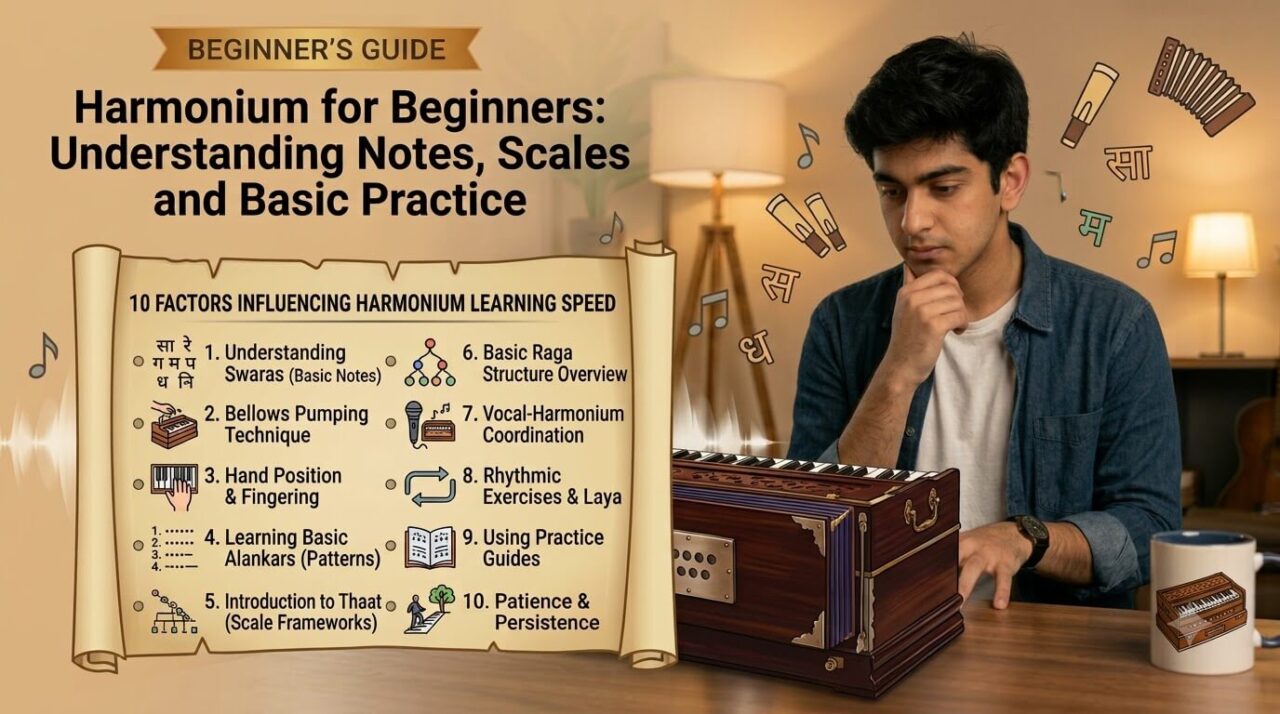
The harmonium has an important place in Indian music. It is commonly associated with devotional music, bhajans, classical vocal practice and musical accompaniment.
For someone seeing a harmonium for the first time, the instrument may appear simple. However, developing good technique and musical understanding requires structured practice.
Beginners who learn the fundamentals correctly can gradually progress from simple notes and melodies to more advanced accompaniment and musical pieces.
Understanding the Harmonium
The harmonium is a keyboard instrument that produces sound through reeds and airflow.
Unlike an electronic keyboard, the player operates the bellows to maintain airflow while using the keys to produce notes.
The combination of hand coordination, airflow and musical understanding makes harmonium learning both practical and engaging.
Learn the Keyboard Layout
The first step is understanding the keys.
Students need to become familiar with the arrangement of notes and develop the ability to locate them without constantly looking down.
This may take time in the beginning.
Simple note exercises can help develop familiarity with the keyboard.
Understanding Swaras
Indian music uses the concept of swaras.
Beginners may be introduced to:
- Sa
- Re
- Ga
- Ma
- Pa
- Dha
- Ni
Understanding these notes provides a foundation for learning melodies and Indian musical concepts.
Practice Scales
Scales help students develop finger coordination and pitch awareness.
Beginners can start with simple exercises before progressing toward more advanced patterns.
Regular scale practice may seem repetitive, but it builds familiarity with notes and improves control.
Learn Proper Hand Position
Hand position matters even when playing simple exercises.
Beginners should learn how to place their fingers comfortably and move between notes without unnecessary tension.
A teacher can identify poor habits early and help students correct them.
Understanding Rhythm
Melody is only one part of music.
Students also need to understand rhythm and timing.
A simple melody played without consistent rhythm may not sound musical.
Practising with a steady beat can help students understand timing.
Harmonium and Singing
Harmonium can be particularly useful for singers.
A singer can use the instrument to establish a reference pitch, practise scales and work on melodies.
It can also provide accompaniment during vocal practice.
This is one reason harmonium is closely associated with Indian vocal music.
Learning Songs
Once students understand basic notes and rhythm, they can begin learning simple songs.
Learning songs can make practice more enjoyable and help students apply theoretical concepts.
However, songs should be chosen according to the learner’s ability.
Starting with very difficult compositions can make beginners frustrated.
Importance of Regular Practice
Harmonium skills develop gradually.
A consistent routine may include:
- Note exercises
- Scale practice
- Finger exercises
- Rhythm
- Song practice
- Revision
Even short sessions can be productive when performed regularly.
Harmonium for Children
Children can learn harmonium when the teaching approach is appropriate for their age.
The first lessons should be simple and engaging.
Instead of focusing only on technical exercises, teachers can introduce familiar melodies to keep children interested.
Harmonium for Adults
Adults can also start harmonium without previous experience.
Some adults learn for devotional singing, some for personal enjoyment and others because of an interest in Indian music.
The learning path can be adjusted according to the student’s objective.
Choosing Harmonium Classes in Surat
When looking for harmonium classes in Surat, students should consider the instructor’s experience, course structure, practical learning and individual guidance.
A teacher can help students understand both the instrument and the musical concepts behind it.
Jays Octave offers harmonium as one of its core music courses alongside guitar, piano, keyboard, singing and tabla. The school also provides options for different age groups and online learning.
Common Beginner Mistakes
Pressing Keys Without Understanding Notes
Students should gradually learn what they are playing rather than simply memorising finger movements.
Ignoring Rhythm
Melody without rhythm can become difficult to perform musically.
Playing Too Quickly
Accuracy should come before speed.
Skipping Practice
Inconsistent practice makes it harder to remember notes and techniques.
Learning Only Songs
Songs are enjoyable, but technical exercises are also important for long-term development.
How Long Does It Take to Learn Harmonium?
The answer depends on the student’s goals and practice.
A beginner may learn simple melodies relatively early, while developing advanced accompaniment skills requires much more experience.
The important thing is to maintain consistent progress.
Final Thoughts
Harmonium is an excellent instrument for anyone interested in Indian music, singing and musical accompaniment.
Start with notes, learn basic scales, develop proper hand coordination and gradually move toward songs and more advanced techniques.
If you are looking for harmonium lessons in Surat, structured training can provide a strong foundation and make the learning process more enjoyable.
Frequently Asked Questions
Can beginners learn harmonium?
Yes. Harmonium can be introduced step-by-step to complete beginners.
Is harmonium useful for singers?
Yes. It can help singers practise notes, scales and melodies.
Can children learn harmonium?
Yes, when lessons are adapted to their age and ability.
Do I need previous music experience?
No. Beginners can start from the basics.
How often should I practise?
Regular practice is recommended for steady progress.