
One of the first questions many new piano students ask is: “How long will it take me to learn piano?” There is no single answer because piano learning is not a race. Someone who wants to play a few favourite songs has a very different goal from someone preparing for advanced performance. The good news...
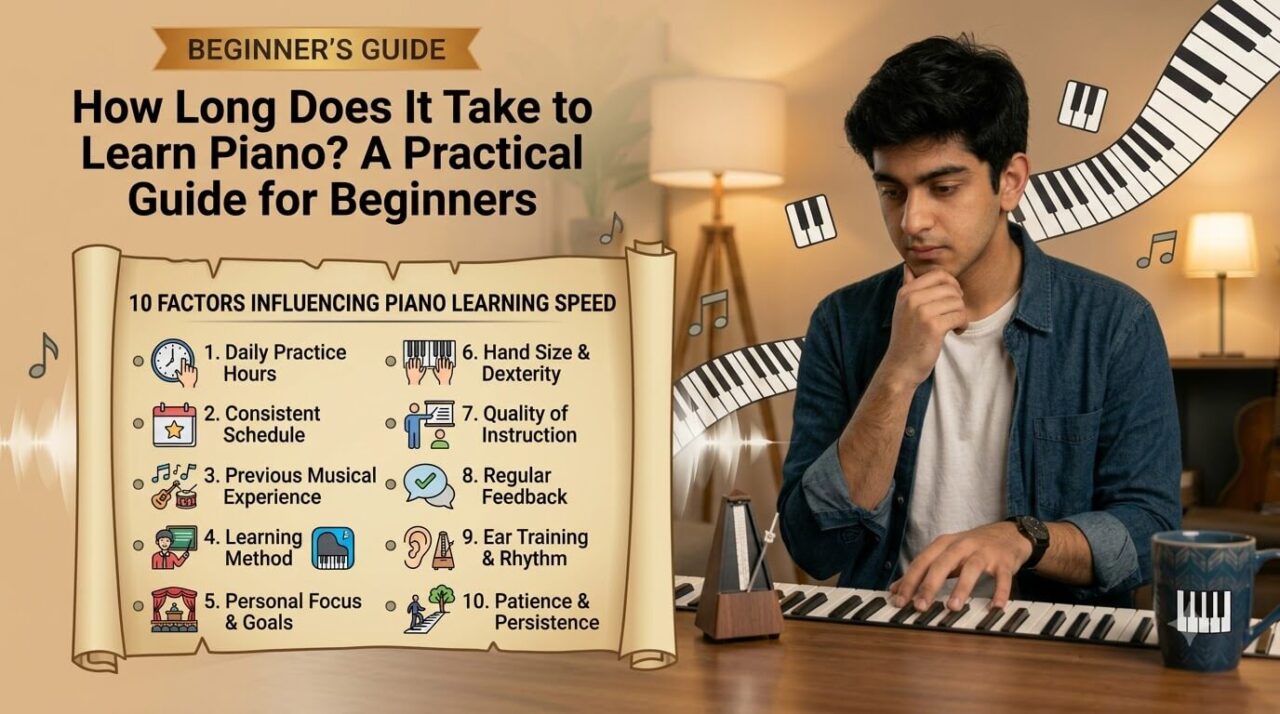
One of the first questions many new piano students ask is: “How long will it take me to learn piano?”
There is no single answer because piano learning is not a race. Someone who wants to play a few favourite songs has a very different goal from someone preparing for advanced performance.
The good news is that beginners can start experiencing progress relatively early when they practise consistently and learn with proper guidance.
What Does “Learning Piano” Actually Mean?
Before discussing time, it is important to understand what learning piano means.
For one student, learning piano may mean playing simple melodies. For another, it may mean reading sheet music, accompanying singers or performing advanced compositions.
Piano has many levels of development:
- Complete beginner
- Basic player
- Intermediate player
- Advanced player
- Performance-level musician
Each stage requires different skills and practice.
The First Few Weeks
During the beginning stage, students usually become familiar with the instrument.
They may learn:
- Piano keys
- Finger positioning
- Musical notes
- Basic rhythm
- Simple exercises
- Basic scales
- Simple melodies
The main goal is not speed. It is developing comfort with the instrument.
Beginners often need time to coordinate both hands.
After the First Few Months
With consistent practice, students can gradually start combining different concepts.
They may learn basic chords, scales, simple accompaniment patterns and more complete songs.
At this stage, students may also begin reading music more confidently.
Progress depends heavily on practice quality.
What Determines How Fast You Learn?
Practice Consistency
Regular practice is one of the biggest factors.
Practising for a short period several times a week can be more useful than playing for several hours once every two weeks.
Previous Musical Experience
Students who already understand rhythm, notes or another instrument may adapt more quickly.
However, complete beginners can also make excellent progress.
Teacher Guidance
A teacher can identify mistakes and create appropriate exercises.
Without guidance, beginners sometimes practise techniques incorrectly for long periods.
Difficulty of the Music
Playing a simple song is very different from performing a complex classical composition.
Your goal affects the learning timeline.
Why Piano Technique Matters
Piano is not only about pressing the correct keys.
Students gradually develop:
- Finger independence
- Hand coordination
- Rhythm
- Dynamics
- Articulation
- Pedalling
- Musical expression
Developing these skills takes time.
Learning Piano by Reading Music
Music reading can initially seem difficult, but it becomes easier through repetition.
Students learn to recognise notes and rhythms rather than reading each symbol as a completely new concept.
Regular reading practice can gradually improve speed and accuracy.
Learning Piano by Ear
Playing by ear is another useful skill.
Some students can hear a melody and reproduce it without written music.
This skill can be developed through listening exercises and practice.
Jays Octave’s piano learning program includes areas such as playing by ear, chord charts, scales, hand position, advanced pedalling and polyrhythms.
Piano for Children
Children can begin piano learning through structured and age-appropriate lessons.
The teaching approach should keep lessons engaging while gradually developing technique.
Children may benefit from learning simple melodies first and then progressing toward more complex pieces.
Piano for Adults
Adults often worry that they are too old to learn piano.
That is not the case.
Adults can begin learning at any stage of life. In fact, adult learners often have clear goals and strong motivation.
The biggest challenge is usually finding consistent practice time.
How Much Should You Practise?
Practice requirements vary.
A beginner might create a routine of 20–30 minutes several days per week.
As skills increase, students may spend longer periods working on technique, repertoire and musical expression.
A practice session can include:
- Warm-up
- Scales
- Technical exercises
- Reading
- Song practice
- Difficult sections
- Review
Why Professional Lessons Can Help
Self-learning can be useful, but beginners may struggle to identify technical problems.
A teacher can provide immediate feedback and explain difficult concepts in a simpler way.
Jays Octave offers piano learning for Kids, Teens and Adults and provides offline, private and online learning options.
For people considering piano classes in Surat, structured learning can provide a clearer progression from basic concepts to more advanced skills.
Don’t Compare Your Progress
One of the biggest mistakes students make is comparing themselves with other learners.
Someone else may have started earlier, practise more frequently or already have musical experience.
Instead, compare your current ability with your previous ability.
Can you play something today that you couldn’t play last month?
If yes, you are progressing.
Final Thoughts
Learning piano is a long-term journey, but beginners can start enjoying the instrument relatively early.
The key ingredients are:
- Proper guidance
- Regular practice
- Patience
- Good technique
- Enjoyment
Whether your goal is to play songs at home, accompany another musician or eventually perform professionally, consistent learning will help you move forward.
If you are considering piano lessons in Surat, choosing a structured program that matches your age and musical goals can be an excellent starting point.
Frequently Asked Questions
How quickly can a beginner play a song on piano?
It depends on the song and the learner, but simple pieces can often be introduced during the early stages.
Is piano difficult to learn?
Piano requires coordination and practice, but structured lessons can make the learning process easier.
Can adults learn piano?
Absolutely. Adults can begin piano at any age.
How often should I practise piano?
Regular practice several times per week is a good starting point.
Can I learn piano online?
Yes. Live online lessons can provide structured instruction when taught properly.