
Music is often considered a form of entertainment, but learning music can be much more than that. Whether someone learns guitar, piano, keyboard, singing, harmonium or tabla, the process involves listening, concentration, memory, coordination, creativity and regular practice. The benefits are not limited to children. Teenagers and adults can also enjoy the creative and personal...
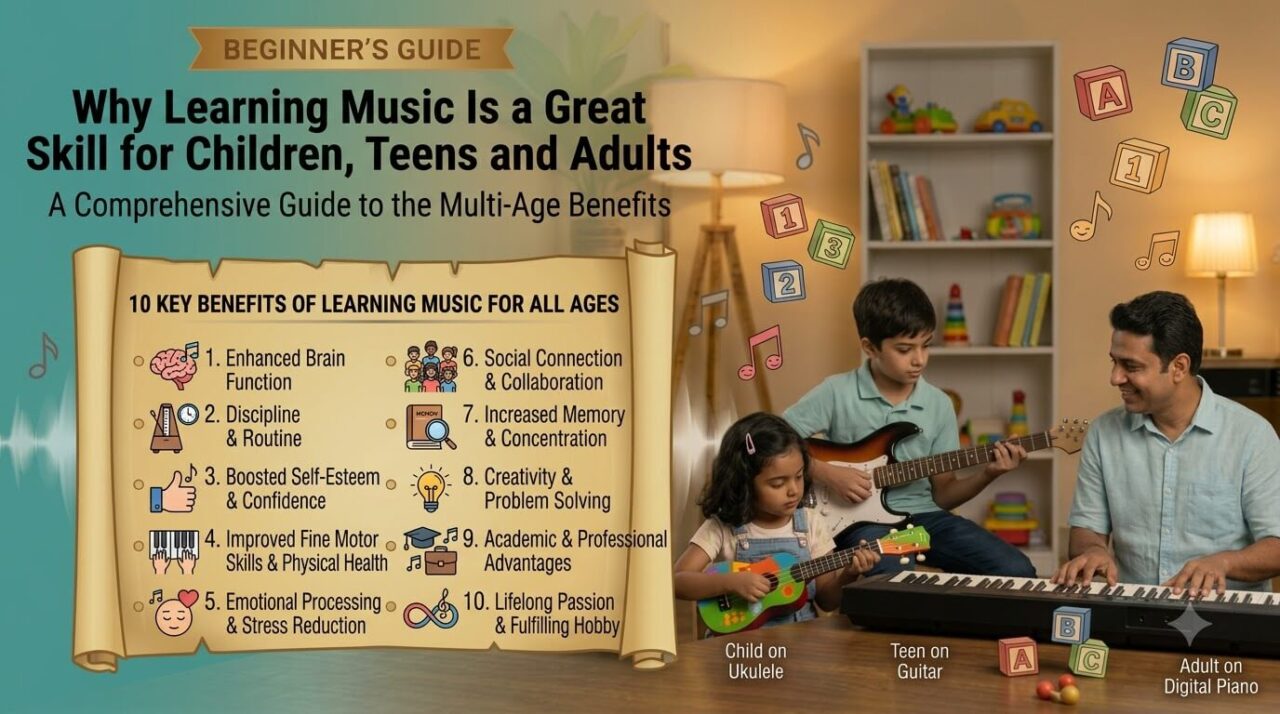
Music is often considered a form of entertainment, but learning music can be much more than that.
Whether someone learns guitar, piano, keyboard, singing, harmonium or tabla, the process involves listening, concentration, memory, coordination, creativity and regular practice.
The benefits are not limited to children. Teenagers and adults can also enjoy the creative and personal benefits of developing musical skills.
Music Is a Skill, Not Just a Hobby
When someone learns an instrument, they are learning how to understand and create music.
Students gradually develop the ability to recognise notes, rhythm, patterns and musical structures.
This makes music a skill that can continue developing for years.
Music and Concentration
Learning an instrument requires attention.
A student may need to read notes, listen to rhythm, remember a pattern and coordinate both hands at the same time.
This type of focused activity encourages students to pay attention to multiple elements.
Music and Memory
Music involves a significant amount of memorisation.
Students may remember:
- Notes
- Chords
- Scales
- Lyrics
- Rhythmic patterns
- Musical structures
- Song arrangements
Regular practice helps reinforce these patterns.
Music Encourages Creativity
Music provides an opportunity for creative expression.
Two musicians can perform the same song but interpret it differently.
Students gradually learn how to express emotion through dynamics, phrasing, rhythm and musical choices.
Music and Confidence
Performing a song in front of others can be challenging.
However, successfully completing a performance can build confidence.
Students can begin with small performances and gradually become more comfortable.
Jays Octave has organised student musical performances and events, giving students opportunities to experience music beyond regular classroom learning.
Music Teaches Patience
Musical skills rarely develop overnight.
Students often repeat the same exercise many times before it becomes comfortable.
This teaches an important lesson: improvement comes through consistent effort.
This mindset can be valuable beyond music.
Music for Children
For children, music can become a creative part of their development.
They can explore instruments, singing and rhythm while learning how to practise and listen.
The teaching approach should remain age-appropriate and enjoyable.
Jays Octave offers music learning for Kids, Teens and Adults across multiple disciplines.
Music for Teenagers
Teenagers often have strong musical preferences.
Some enjoy guitar and contemporary music, while others are interested in piano, keyboard, singing or Indian instruments.
Allowing teenagers to connect lessons with the music they enjoy can make learning more engaging.
Music for Adults
Adults often believe that they are too busy or too old to start learning music.
Neither has to be true.
Adults can learn music as a hobby, a creative activity or a long-term personal goal.
Even limited practice time can produce progress when used consistently.
Choosing the Right Instrument
There are many possibilities.
Guitar
Suitable for people interested in chords, rhythm and contemporary music.
Piano
Useful for learning melody, harmony and music theory.
Keyboard
Offers flexibility through different sounds and rhythms.
Singing
Develops vocal technique, pitch and musical expression.
Harmonium
Connects particularly well with Indian vocal and devotional music.
Tabla
Provides a strong foundation in rhythm and Indian percussion.
Jays Octave currently offers all six of these disciplines.
Music Theory Matters
Some students want to learn songs without studying theory.
While songs are an important part of practical learning, understanding basic theory can make long-term progress easier.
Music theory helps students understand:
- Notes
- Scales
- Chords
- Rhythm
- Keys
- Musical structure
Theory and practical learning work best together.
Learning With a Teacher
A structured teacher can provide feedback, answer questions and help students progress logically.
This can be especially valuable for beginners who may otherwise develop incorrect techniques.
Jays Octave provides offline, private, group and online learning options, allowing students to choose an approach that fits their circumstances.
Learning Music in Surat
For students searching for music classes in Surat, location is only one factor.
Parents and students should also consider the curriculum, instructors, learning environment, class format and opportunities to practise and perform.
A good music academy should provide more than isolated lessons. It should help students develop a relationship with music.
How to Stay Motivated
Motivation can change over time.
Students can stay engaged by:
- Learning songs they enjoy
- Setting small goals
- Recording their progress
- Performing occasionally
- Practising with friends
- Trying different musical styles
Progress becomes more visible when goals are measurable.
Instead of saying “I want to become better at guitar,” set a goal such as “I want to learn three complete songs this month.”
Music as a Lifelong Journey
There is no final point in music.
Even professional musicians continue learning.
Beginners learn basic skills. Intermediate students develop technique. Advanced musicians explore interpretation, improvisation and performance.
This makes music an activity that can continue throughout life.
Final Thoughts
Learning music can provide much more than the ability to play an instrument.
It can encourage concentration, creativity, discipline, confidence, listening and self-expression.
Whether you are a parent looking for music lessons for your child, a teenager interested in developing a musical skill or an adult finally pursuing an old interest, there is no need to wait for the “perfect” time to begin.
If you are exploring music classes in Surat, consider your interests, goals and preferred learning style before choosing an instrument and course.
Jays Octave offers Guitar, Piano, Keyboard, Singing, Harmonium and Tabla learning for different age groups and also provides online and private learning options.
Frequently Asked Questions
Is learning music useful for children?
Music can encourage concentration, creativity, coordination and discipline while providing a creative activity.
Can adults start learning music?
Yes. Adults can begin learning music regardless of previous experience.
Which musical instrument should I learn?
Choose an instrument based on your interests, musical goals and preferred style.
Do I need previous musical experience?
No. Beginners can start from basic concepts.
Can music be learned online?
Yes. Live online lessons can provide structured learning with teacher guidance.
How long does it take to learn music?
There is no fixed timeline. Progress depends on the instrument, goals, practice consistency and individual learning pace.