
Tabla is one of the most recognisable percussion instruments in Indian music. It plays an important role in classical performances, devotional music, accompaniment and many other musical settings. Unlike instruments where students primarily focus on melody, tabla learning is strongly connected with rhythm, timing, coordination and memory. For beginners, the terminology and rhythmic patterns may...
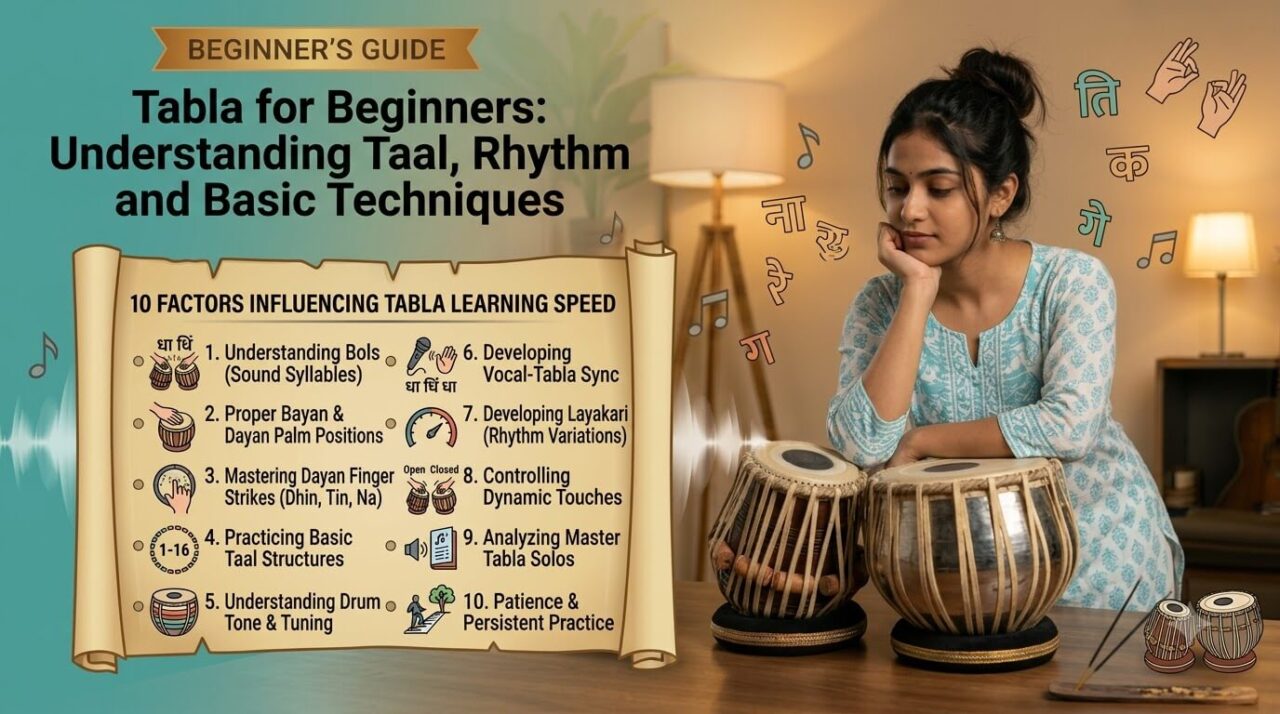
Tabla is one of the most recognisable percussion instruments in Indian music. It plays an important role in classical performances, devotional music, accompaniment and many other musical settings.
Unlike instruments where students primarily focus on melody, tabla learning is strongly connected with rhythm, timing, coordination and memory.
For beginners, the terminology and rhythmic patterns may initially seem difficult. However, learning the basics step by step can make the instrument much easier to understand.
What Is Tabla?
Tabla consists of two drums played with the hands.
The smaller drum is commonly known as the dayan, while the larger drum is known as the bayan.
Together, they create a wide range of tones and rhythmic patterns.
The instrument requires controlled finger and hand movements, which students develop gradually through practice.
Why Learn Tabla?
Tabla can develop several musical skills.
Students can improve:
- Rhythm
- Timing
- Concentration
- Hand coordination
- Listening
- Memory
- Musical discipline
These skills are useful not only for tabla but also for other areas of music.
Start With Correct Sitting Position
Beginners should first learn how to sit comfortably with the instrument positioned correctly.
Proper positioning makes it easier to use both hands and practise strokes accurately.
A teacher can help students develop good habits from the beginning.
Learn Basic Strokes
Tabla uses different strokes and combinations.
Beginners gradually learn the basic sounds and movements before combining them into more complex patterns.
Accuracy is more important than speed.
Students should first aim to produce clear and consistent sounds.
Understanding Bols
Tabla uses syllables known as bols to represent different strokes and rhythmic patterns.
Learning bols helps students remember and communicate compositions.
Instead of memorising patterns only through physical movements, students can learn to recite them and understand their structure.
What Is Taal?
Taal refers to a rhythmic cycle in Indian music.
It provides a framework within which rhythmic patterns are performed.
Beginners gradually become familiar with different taals and learn how beats are organised.
Understanding taal is essential for developing rhythmic awareness.
Why Rhythm Practice Matters
Tabla is fundamentally connected to rhythm.
A student may know individual strokes but still struggle to perform a complete rhythmic pattern.
Regular practice with counting, clapping and recitation can help students internalise timing.
This is why tabla learning involves both physical and mental practice.
Tabla and Other Instruments
Tabla does not have to be learned in isolation.
It can complement singing, harmonium and other musical instruments.
For example, singers can benefit from understanding taal because it helps them maintain rhythm while performing.
Students who learn multiple instruments may also find that tabla improves their overall rhythmic awareness.
Tabla for Children
Children can begin learning tabla through simple exercises.
The teaching process should be adapted to their age and attention span.
Fun rhythm activities can make lessons more engaging while gradually introducing technical concepts.
Tabla for Adults
Adults can also learn tabla as a hobby or as part of a deeper interest in Indian music.
The pace can be adjusted according to the student’s schedule and goals.
Adults may especially benefit from structured practice because it helps them use limited practice time efficiently.
How to Practise Tabla
A good practice routine can include:
- Sitting and positioning
- Basic strokes
- Bol recitation
- Simple rhythmic patterns
- Taal practice
- Repetition
- Review
The exact routine should depend on the student’s level.
Common Tabla Learning Mistakes
Focusing Only on Speed
Fast playing does not automatically mean good playing.
Accuracy and clarity should come first.
Ignoring Technique
Incorrect hand movements can make advanced playing more difficult.
Skipping Basic Bols
Fundamental bols are the building blocks for more advanced compositions.
Practising Without Rhythm
Students should learn to maintain a steady cycle rather than playing individual strokes randomly.
Choosing Tabla Classes in Surat
Students looking for tabla classes in Surat should consider the instructor’s experience, learning structure, practical exercises and individual feedback.
Tabla is an instrument where proper technique and rhythmic understanding matter greatly.
Jays Octave includes Tabla among its music courses and provides learning options alongside Guitar, Piano, Keyboard, Singing and Harmonium.
How Long Does It Take to Learn Tabla?
Simple rhythmic exercises can be introduced during the early stages.
However, becoming comfortable with more advanced taals, compositions and performance requires consistent practice over time.
There is no fixed timeline because every student progresses differently.
Final Thoughts
Tabla is much more than a percussion instrument. It is a complete study of rhythm, coordination, listening and discipline.
Beginners should focus on correct technique, basic strokes, bols and taal before attempting complex patterns.
With regular practice and proper instruction, students can gradually develop confidence and musical understanding.
If you are interested in learning tabla in Surat, starting with structured beginner lessons can provide a strong foundation.
Frequently Asked Questions
Can beginners learn tabla?
Yes. Beginners can start with basic strokes and rhythmic exercises.
What age can children start tabla?
It depends on the child, but age-appropriate lessons can introduce children to rhythm and basic techniques.
Is tabla difficult to learn?
Tabla requires practice and coordination, but structured instruction makes the learning process easier.
What is taal in tabla?
Taal is a rhythmic cycle that provides a framework for Indian music.
Can tabla help singers?
Yes. Understanding rhythm can be valuable for singers and other musicians.